At the opening of Votive, before the voice enters, the piano states four bare notes: a rising tone, a falling semitone, a falling third. It is the smallest possible gesture — the lighting of a flame — and across the next thirteen songs it is inverted, reversed, stretched, ground down to a chaconne bass, and finally heard only as its own shadow.
This is the oldest device in the composer's craft: cyclic unity, the principle by which Wagner, Franck and Berg bound an hour of music into one breath. To follow the lamp motif through Das Verlöschen is to watch a single flame pass from hand to hand until it gutters out.
The motif & its transformations
Prime
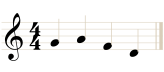
Inversion
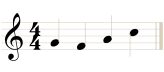
Retrograde
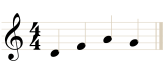
Augmentation
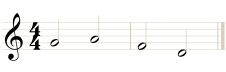
The tonal architecture
The cycle is one long descent. It opens in luminous E major and falls, song by song, to the final B-flat minor — with a single warm flat-side oasis at its centre (the memory-song, No. 6) and one last major-key blaze (the green flash, No. 11) before the dark closes in.
- 01 Votive E major
- 02 The Wick Burns Low C-sharp minor
- 03 Ground of Stars B minor
- 04 The Last Ember B minor
- 05 Foxfire A minor
- 06 The Lamp I Kept for You A-flat major
- 07 The Miner's Lamp G minor
- 08 Lullaby for Stranded Light F-sharp minor
- 09 Against the Dawn F minor
- 10 Variations on a Dying Flame E-flat minor
- 11 The Green Flash D-flat major
- 12 The Pilot Light C minor
- 13 The Headland Dark B minor
- 14 Das Verlöschen B-flat minor
Every documented appearance
| Work | Transformation | Hear it |
|---|---|---|
| Das Verlöschen | Lamp motif (shadow, final) | 5:50 |
| The Lamp I Kept for You | Lamp motif (inversion) | 0:38 |
| The Pilot Light | Lamp motif (inversion, fortissimo) | 4:00 |
| Variations on a Dying Flame | Lamp motif (as chaconne ground) | 0:00 |
| Votive | Lamp motif (prime) | 0:04 |